The shared bar for Muslim businesses.
The public business directory is still being validated, the same way we’ve flagged on the directory page itself. Business owners can claim a listing today and post attestations against the six dimensions in advance of the directory going public, so the page launches with your own evidence already on it. Same verification flow as the nonprofit side: 990 contact email (for orgs that file), org-domain email, or manual review with documentation, an IRS determination letter, or an EIN-on-letterhead equivalent for businesses.
Muslim-owned and Muslim-serving businesses are evaluated, first, on whether they live up to Islamic mandates in their operations and dealings, no interest-bearing accounts, no haram transactions or investments, zakat paid on inventory and corporate assets, and ethical and community vendors preferred where they meet the standard. On top of that, the usual: how much they give back, how they treat the earth, whether they’re in good public-record standing, and whether their halal claims actually hold up at the issuer.
Businesses that reach the bar get visibly recognized, featured on the Ihsan Standard directory, listed on the vendor lists promoted by Muslim nonprofits and other audited businesses in the network, and pinned brighter on NoorMap, the most comprehensive public map of Muslim spaces in the US. This is the answer to the question the ummah has been asking: how do we go from a directory of Muslim businesses to Muslim businesses actually supporting each other for collective empowerment? A shared standard, and the framework to live up to it.
- Businesses listed
- 60,780
- States covered
- 50
- Dimensions scored
- 6
- Audited (pilot)
- Waitlist
50 US states are live; ~12 international entries pulled in for NoorMap launch later.
Six dimensions, scored independently.
Each business gets a separate score on each dimension. A halal butcher with a current issuer certificate and a clean regulatory record scores high on BH and BC even if it hasn’t published a community-giving statement yet. The directory shows you each cell honestly, including the empty ones.
- BZ
Zakat & financial discipline
Live up to the Islamic mandates the business is built on.
Owners' zakat paid on the business's zakatable wealth (inventory, receivables, and cash reserves) with a documented calculation. No interest-bearing operating accounts. No haram transactions or investments, reserves and treasury sit in shariah-compliant instruments only. The financial backbone of a Muslim business, made visible.
- BV
Community vendor commitment
Money should recirculate inside the community when the quality is there.
How deliberately the business sources from Muslim-owned and community suppliers when comparable alternatives meet or exceed the commercial standard, hosting, payroll, accounting, insurance, signage, printing, IT, raw materials, logistics. Ethical sourcing in general (not just community sourcing) belongs here too.
- BH
Halal & product integrity
If the label says halal, does the certificate exist, and is it current?
Halal claims, freshness of certification, third-party issuer credibility, and product-recall history. The dimension that matters most to the Muslim consumer at the moment of purchase, and the easiest to fake without an issuer-side check.
- BG
Community give-back
What share of the business comes back to the Ummah.
What share of revenue, profit, or staff time the business returns to the Muslim community, through sadaqa, in-kind support of masjids and Muslim nonprofits, sponsorship of community programs, scholarship funds, and paid time off for community service. Separate from the owners' zakat on business wealth (a religious obligation on the owner, not voluntary giving).
- BE
Environmental stewardship
Khulafāʾ al-arḍ, stewardship of the earth, applied to operations.
Energy, waste, packaging, supply-chain footprint, and substantive (non-cosmetic) climate commitments. Verified third-party certification is weighted higher than self-claimed badges. For restaurants and businesses that source meat: not just halal but tayyab, meaning sourced from animals that were treated ethically before slaughter, raised with care, fed properly, and slaughtered humanely. Stewardship of the earth (Khulafāʾ al-Arḍ) applied to operations means we ask: were we truly good stewards in how this animal was raised and how this food got to the table?
- BC
Regulatory & operational integrity
Is the business in good standing with the public record?
Basic compliance health from public records, corporate registration in good standing, no material labor / safety / consumer-protection violations, no unresolved court judgments. Cheap to verify, expensive to fake. The minimum bar for any business asking the community for trust.
One ledger. Every Muslim business we can verify.
Ihsan Standard is both the catalog and the rubric. We aggregate from public-record APIs, certifier registries, state SoS data, and community submissions, then apply the published six-dimension rubric and post the score here. Each business has a stable identity owners can claim and update.
The scored catalog
60780 US Muslim businesses, scored against the six-dimension rubric. Halal certifications, regulatory standing, and community give-back surfaced honestly.
Claim your listing
Verify ownership through UmmahPassport SSO, edit your listing, submit evidence on each dimension (certificates, sourcing policy, community-giving statement), and request a re-score.
Audited listings come first in vendor recommendations.
Halal-certified, owner-claimed, and audited listings are featured first across our directory and on NoorMap. Other listings still appear so the directory stays comprehensive, but the featured tier rewards real engagement.
Practical translation: if you commit to community giving on the BG dimension, name a Muslim-vendor sourcing policy on BV, or submit your halal certificate, you move up. Buyers see you first.
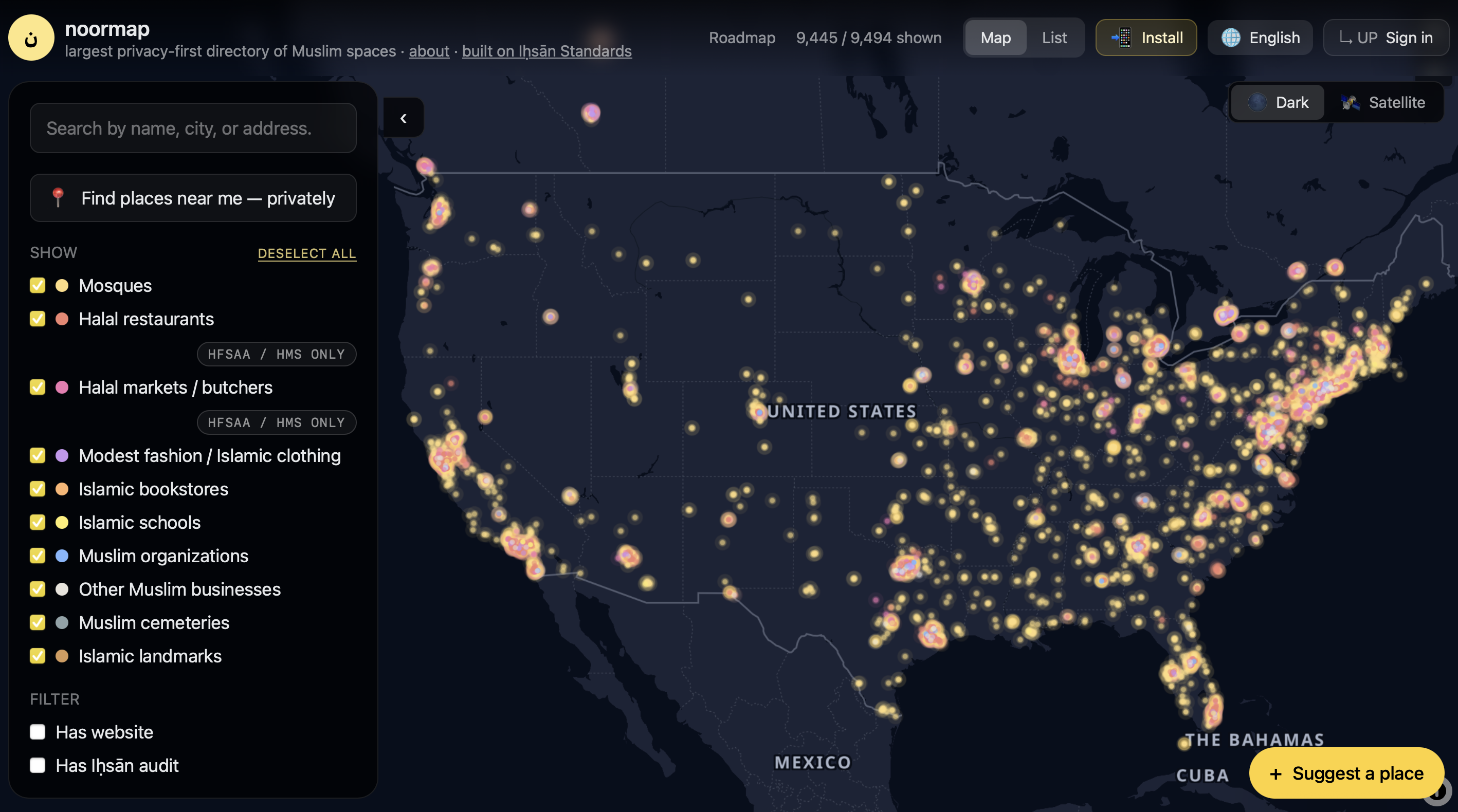
Illustrative. Audited businesses pin brighter on the live map.
Claim. Edit. Submit evidence. Or request removal.
Every business in the directory can be claimed by its owner through UmmahPassport SSO. Claiming unlocks editing the listing, submitting evidence on each dimension (certificates, sourcing policy, community-giving statement), and requesting a re-score. We score against a public rubric and we publish the right-of-reply on every page.
If you’d rather your business not be listed publicly, request takedown. That’s a legitimate choice, we honor takedown requests and we’ll work towards a fast turnaround as we scale. Just owner identity verification, no other proof needed. The directory is comprehensive, not forced visibility.
Members of the public can also flag an inaccurate Muslim-owned listing, use the Report link on the tile in the directory and tell us what’s wrong. We follow up before removing or correcting.